/137/1/16203046156093e2e7ba3a1_romans-international-logo-black-23.05.png)
/137/1/162513748360dda14b60068_romans-international-logo-whiteout.png)
The Anatomy of a Supercar: Finding the “Perfect” Spec
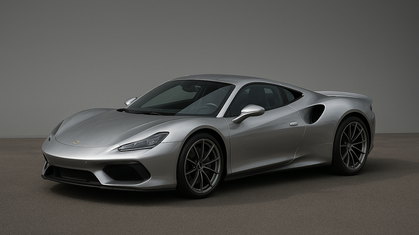
Everyone will have their own opinion on the “perfect” supercar, and it’s hotly debated across the likes of YouTube, Reddit and social media platforms. But there’s no real definitive answer. After all, it is completely subjective.
However, with some of the most iconic cars passing through our showrooms every week, we thought we’d give it our best shot to understand what the “perfect” supercar looks like using the data of dozens of our favourite models.
Taking all the major specifications across dozens of our favourite supercars, we’ve crunched the numbers to create the perfect spec and rendered exactly what it would look like. Tell us what you think…
Looking for your own perfect supercar? Check out our current stock.
The Perfect Supercar: A Snapshot
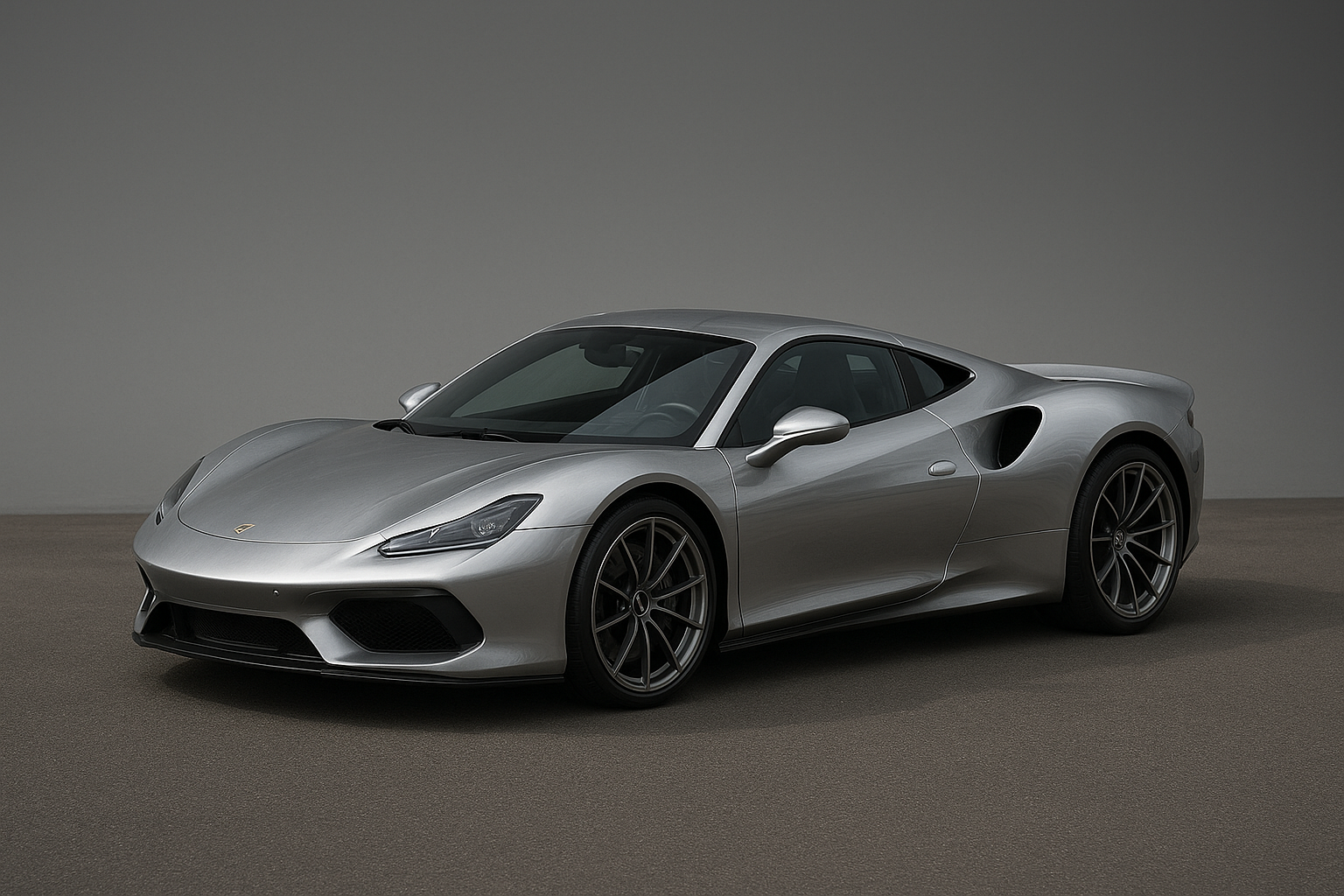
To create our perfect supercar, we analysed 40 supercars across multiple brands and models, comparing engine size, dimensions, body style, door type, and build materials, then used the overall averages to design our own.
Using AI, we then built out the car, giving it a full spec and even a name: The PJ468.
Let’s jump into those details…
The PJ468: The classic naming system

We’ll start with the name. Introducing the PJ468.
We’ve stuck to a classic naming structure and the most common inspiration for naming models. Across our study, the taxonomy of names could be typically broken down into three: what’s under the bonnet, people and places, and animals.
Perhaps the most iconic when it comes to the latter can be found in Lamborghini, where each model is named after a bull, while the likes of Porsche have also used animals. However, Porsche, of course, also use their classic number sequencing too, found with the 911, 918 and so on.
For our own model, however, we’ve used people and places alongside the engine size. Engine sizes are a real go-to for manufacturers and utilised frequently by Ferrari, McLaren and to a lesser extent, Porsche. Horsepower is also frequently used.
The 468 element of our “perfect” supercar comes from the litre capacity of the car alongside the cylinders of the engine, which we’ll come to later. This is a similar approach to many Ferrari models, from the 296 to the 488, 458 and more.
Then we have the PJ. Over the years, we’ve seen the likes of the McLaren Senna, Bugatti Chiron and various Aston Martins well-loved by our customers, all of which are inspired by greats of the industry. Following in the footsteps of Aston Martin’s DB series, which stands for David Brown, the owner of the company between 1947 and 1972, we’re following suit and honouring our very own Paul Jaconelli for our PJ468.
The Build
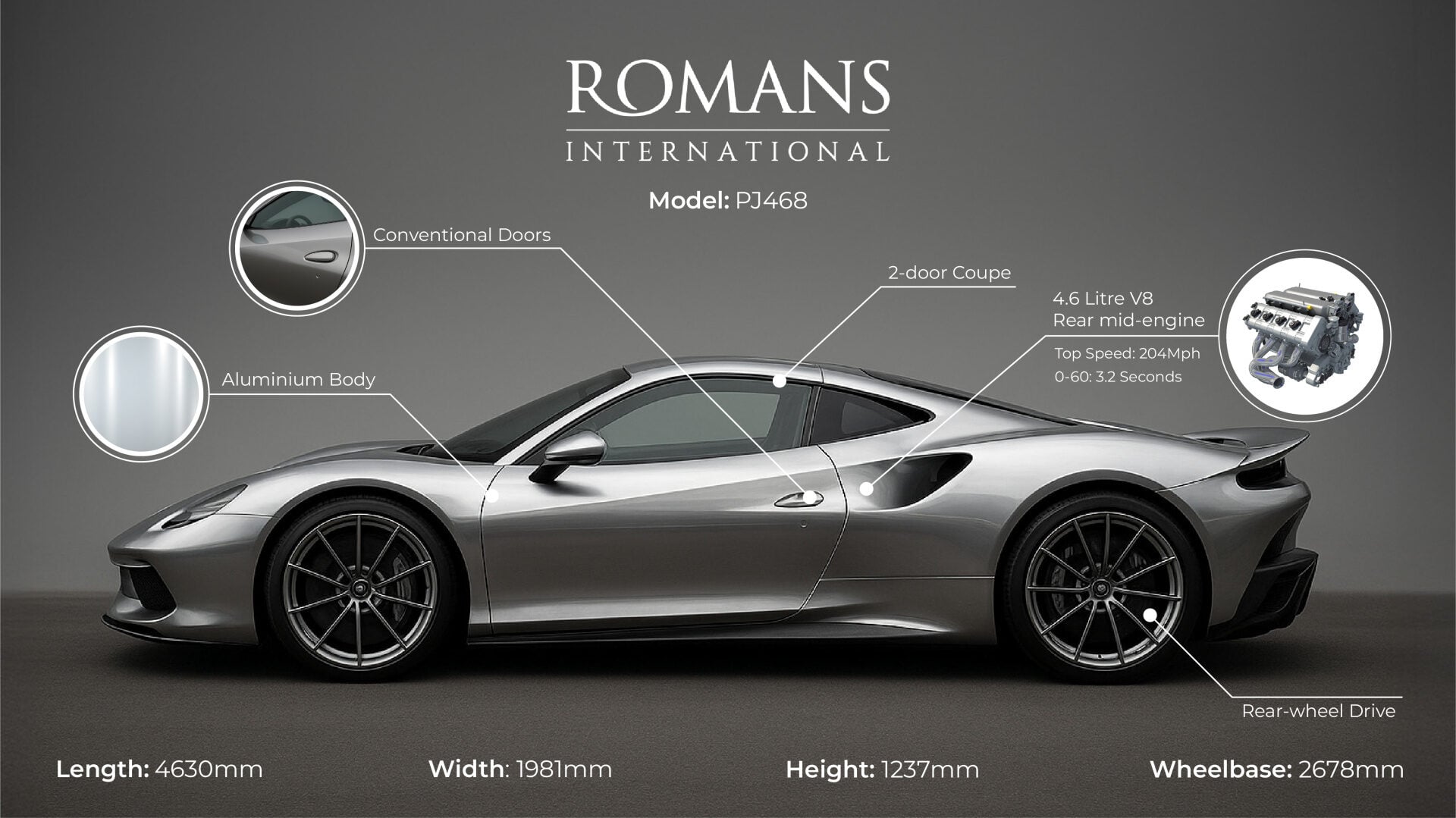
The look and feel of the car largely comes from its build. It was a close call as to whether we opted for an aluminium or carbon fibre body of the car. 55% of cars within our study were aluminium bodies, though, including classics including the Ferrari F8 and the Mercedes-Benz AMG GT.
Conventional doors were far and away the most common and have been integrated into our design ahead of butterfly doors, while the shape itself is a classic two-door coupe design.
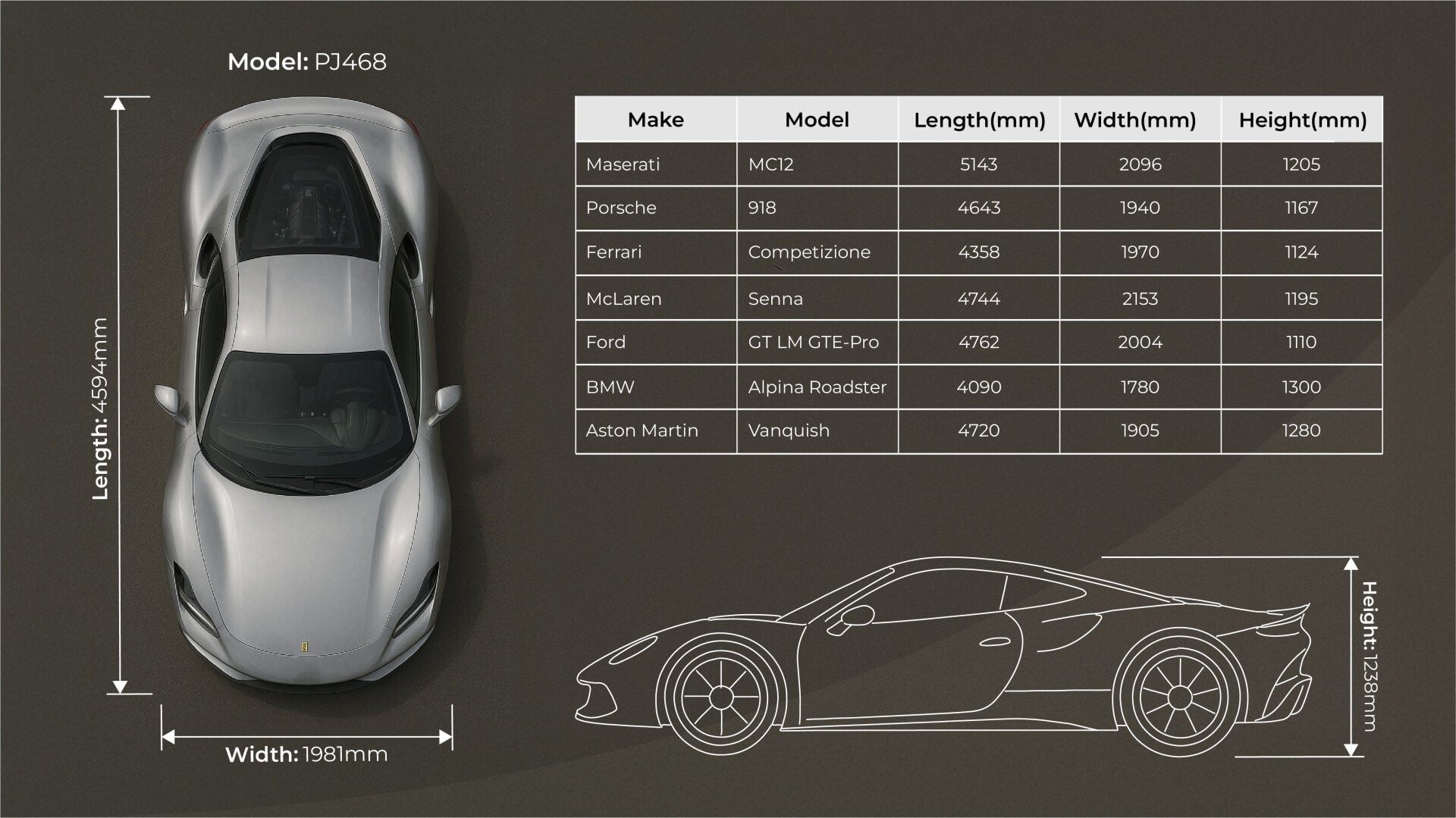
Across all the cars we analysed, all were in a similar ballpark when it came to length, height and width. The Maserati MC12 was the longest supercar within our study at 5,143mm, while it is the Lamborghini Revuelto that is among the widest on the market at 2,266 mm, significantly wider than our 1,981 mm model.
Our final model comes in at 4,594 mm in length, 1,981 mm in width and 1,237 mm in height, placing it just a little bigger than the McLaren 570S and just short of the Ferrari 812 in terms of size.
When it comes to wheelbase, our PJ468 is almost identical to McLaren models, which measure in at 2,670 mm, just 8 mm smaller.
Under the Bonnet
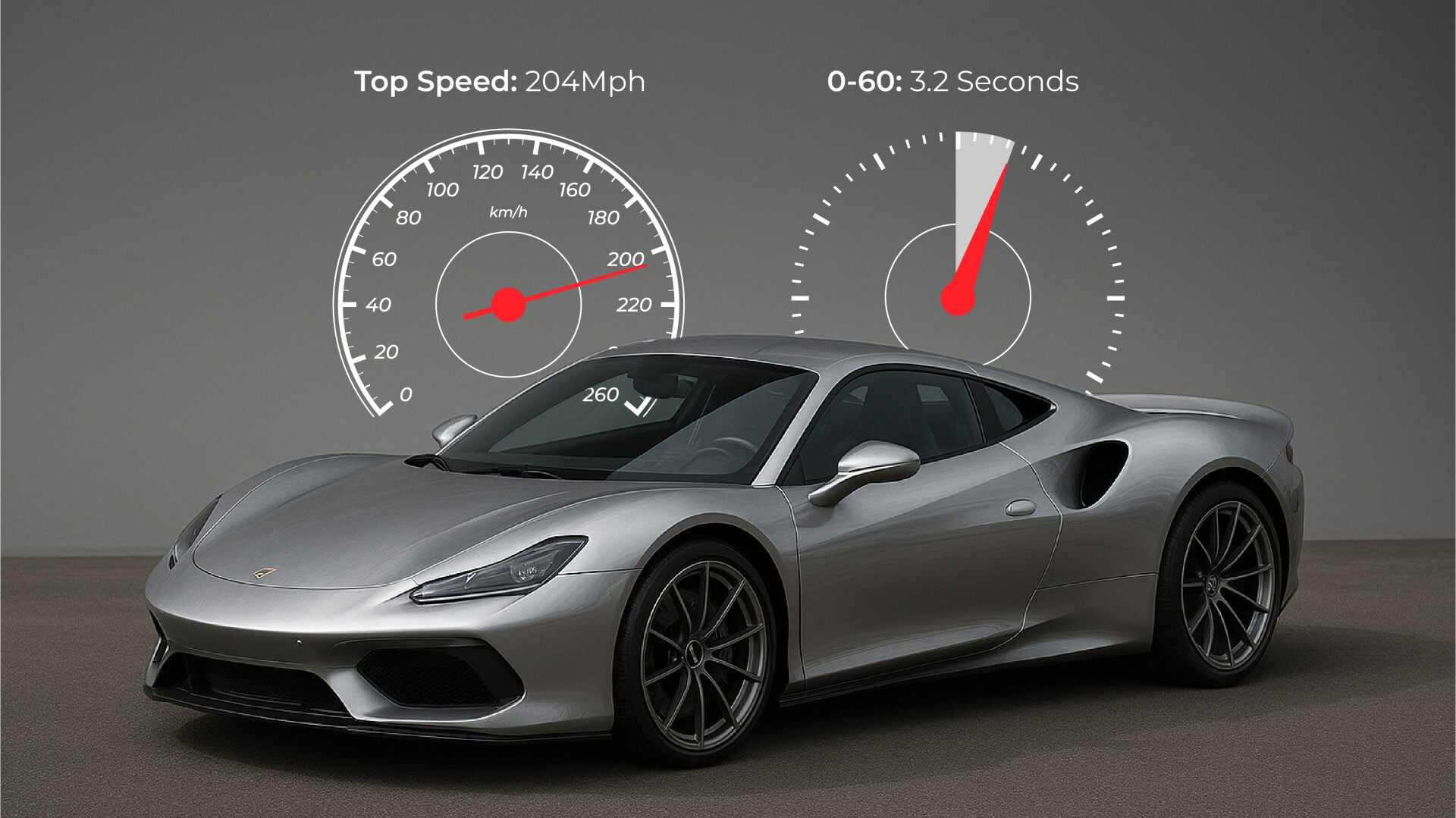
As you may have already guessed from the PJ468’s name, the engine of our perfect supercar based upon the data averages out at a 4.6 litre engine, with a V8 engine, interestingly, exactly the same as the Porsche 918.
Naturally, here we have a spec that’s mid-range and based upon averages, so perhaps not entirely perfect. We’d have to best the Bugatti in such cases. However, where our car sits in terms of engine capacity and performance is exact, as we’ve said with the 918, but also in and around the Ferrari 458, which has a 4.5 litre V8 engine. Like both cars, ours also has a rear mid-engine, a spec that accounts for 51% of all cars studied.
When it comes to speed and 0-60, due to the nature of our statistical breakdown, the PJ468 sits within the middle of the road. With a top speed of 204 mph, it’s very much in line with the McLaren 765LT, Ferrari 296 and Maserati MC12, all of which you can eke out an additional one mile per hour out of.
However, the PJ468 is half a second quicker from 0-60 mph than the MC12, and slightly slower than the 765LT and 296. You’ll reach 60 mph in the exact same time as the Porsche 718, Aston Martin Vanquish and Aston Martin DBS, the latter two of which have much larger engines.
The PJ468 is also rear wheel drive, like 80% of cars within our study.
The Anatomy of a Supercar: Closest to the “Perfect” Spec
Of course, for most of us looking for a supercar, we’re seeking something that’s a little bit different, perhaps outside of the “perfect” spec box. It’s Porsche and Ferrari models that overall most closely align to the full spec of our car and give you, on average, what most are looking for in a supercar.
Lamborghini models stray a little further away and go against that grain, often wider, but also built using carbon fibre and operating with scissor doors. The likes of the Aventador and Revuelto also utilise different naming systems, offer bigger engines and carry higher top speeds, too.
Perfection is, of course, in the eye of the beholder, and whether it be the stylish PJ468 or the current stock we have in our showrooms, our team are available to guide you and find the car that suits your very own “perfect” spec.