

Porsche Mission S: 7 Things You Might Not Know About the New Supercar Above the 911
Porsche's New Supercar Above the 911 - If You Don't Know, Now You Know
Here at Romans International, we've always had a soft spot for Porsche's mid-engined flagships. We've been fortunate enough to sell both the Carrera GT and the 918 Spyder over the years, and every one of them has stopped people in their tracks the moment it rolled into the showroom. So when Porsche pulled the covers off the Porsche Mission S in New York on 15 October 2026, we were paying very close attention indeed.
It's a vision model rather than a finished production car, but it tells you a remarkable amount about the new mid-engined supercar that will sit above the 911. So, in true If You Don't Know, Now You Know fashion, here are seven things you might not know about the Porsche Mission S. Every day is a school day!
Fact 1: The Porsche Mission S Isn't a Limited-Run Hypercar
This is the headline, and it's genuinely a first. Porsche says the Mission S previews a mid-engined super sports car that will be permanently available above the 911. Porsche chief executive Dr Michael Leiters put it simply: the car is coming "not as a one-off hypercar, but as a permanent and versatile addition" to the range.
That's a very different approach from the cars that came before it. The Carrera GT was built in a run of 1,270 cars, and the 918 Spyder was limited to 918 examples, with production ending in 2015. Both were events. The Porsche Mission S points to something you'll be able to order, spec and, crucially, drive.

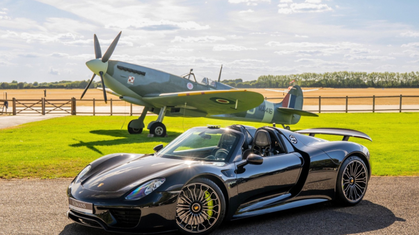
A Basalt Black Porsche 918 Spyder sold by Romans International. Just 918 were built.
Fact 2: It Was Revealed Where Porsche's First Super Sports Car Was Photographed
Porsche didn't pick the location by accident. The Mission S made its world debut on a pier in Queens, New York, looking across to the Manhattan skyline. In 1953, the first photographs of the mid-engined 550 Spyder were taken on that very same pier, and those pictures went around the world.
Porsche describes the 550 Spyder as the brand's first super sports car, and credits it with laying the foundations for its success in America. Bringing the Porsche Mission S back to the exact spot, 73 years later, is about as clear a statement of intent as you'll get from Stuttgart. Subtle bragging rights at their finest!

The 550 Spyder on the same Queens pier in 1953. Image: Porsche AG
Fact 3: The Mission S Design Is a Porsche Greatest Hits
Look closely and the Porsche Mission S is packed with references to Porsche's back catalogue. The round headlights and torpedo-shaped front wings come from the 911, whilst the shut lines that merge into the light graphics nod to the G-model. The flat nose is lifted from the 911 GT1, and so is the "car-in-car" rear end, where the rear wings wrap around and frame the tail.
The roofline beneath the active rear wing is inspired by the 959, the cooling fan behind the cabin is a tribute to the legendary 917, and the wheels reinterpret the 928's "dial" design, staggered at 21 inches up front and 22 at the rear. Truly a car for those who know their Porsche history.

The GT1-inspired car-in-car rear of the Mission S. Image: Porsche AG
[Video embed: Porsche's official Mission S film from the Porsche YouTube channel]
Fact 4: There's No Centre Screen
In an era of dashboards that look like a branch of Currys, the Porsche Mission S goes the other way entirely. Porsche has deliberately left out a fixed centre display and a passenger screen. Instead, there's a retractable MagSafe-compatible holder, so your own phone becomes the navigation and information display when you want it, and disappears when you don't.
Behind the wheel sit five round instruments, with a rev counter that has a proper physical needle. Depending on the drive mode, the rev counter moves closer to the driver, and the other dials either sit side by side or tuck in behind one another. Porsche's teaser even showed it sweeping to an 8,000rpm redline. If five round dials sound familiar, they should. Carrera GT owners will feel right at home.

Five round instruments with a physical rev counter needle in the Mission S. Image: Porsche AG

The Carrera GT's five-dial cluster, photographed at Romans International.
Fact 5: The Key Still Goes on the Left
Some traditions are simply too good to lose. The Porsche Mission S keeps the key holder to the left of the steering wheel, as is customary at Porsche. It's a habit that goes back to the Le Mans running starts, when drivers could fire the car up with their left hand and select a gear with their right.
The rest of the cabin follows the same thinking, with push-pull controls in the dashboard, a reimagined Sport Chrono clock, race-style seatbelt buckles in the seat centres and pull straps for door handles. Porsche says the interior draws on the 550 Spyder and the 356, so you feel like you're sitting deep within the car.